

How Jantar Mantar Became India's Most Famous Protest Site

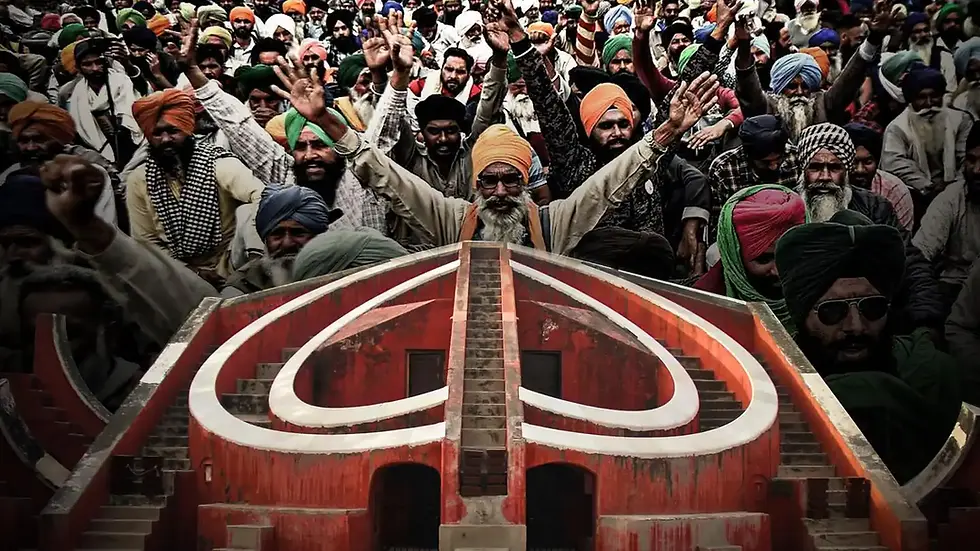
By the heart of New Delhi stands a monument unlike any other. It has no royal throne, no towering fortifications, and no tales of epic battles. Instead, its giant stone structures were designed to do something extraordinary—to read the heavens.
Three centuries ago, astronomers gathered here to calculate time, track planets, and observe the movement of celestial bodies with astonishing precision. Today, those same grounds have witnessed thousands of ordinary citizens gather to seek justice, demand change, and make their voices heard.
Few places in India tell such a remarkable story of transformation as Jantar Mantar—a monument where science, history, architecture, and democracy have come together across generations.

An Observatory Built Ahead of Its Time
Delhi's Jantar Mantar was commissioned in 1724 by Maharaja Sawai Jai Singh II, one of India's greatest patrons of astronomy and mathematics. Fascinated by the mysteries of the cosmos, the ruler believed that existing astronomical calculations needed greater precision.
Rather than relying on small handheld instruments, Jai Singh envisioned enormous masonry structures capable of making highly accurate celestial observations. Delhi's observatory became the first in an ambitious network of five, later followed by observatories in Jaipur, Ujjain, Varanasi, and Mathura.
Its geometric forms—massive ramps, curved walls, towering arcs, and circular instruments—were unlike anything seen in traditional Indian architecture. Every structure had a scientific purpose, whether measuring time through the movement of shadows, calculating the position of stars, or tracking the sun's journey across the sky.
Long before modern telescopes became common, these stone instruments represented some of the finest examples of astronomical engineering in the world.

A Monument Unlike Any Other
The name Jantar Mantar is believed to have evolved from the Sanskrit word yantra, meaning "instrument."
Unlike Delhi's famous forts, palaces, or tombs, Jantar Mantar was never built for kings to live in or armies to defend. It was built entirely for knowledge.
Visitors often find themselves wondering whether they are walking through an art installation, a sculpture garden, or a scientific laboratory. Its bold geometric design continues to fascinate architects, historians, scientists, and tourists alike.
Even after more than 300 years, it remains one of India's rare monuments dedicated solely to scientific discovery—a lasting reminder of the country's rich tradition of astronomy.
When History Took a Different Turn
As centuries passed, the purpose of Jantar Mantar quietly began to change.
During much of the twentieth century, large public demonstrations in Delhi were held at the Boat Club lawns near India Gate. However, following major protests during the 1980s, authorities shifted most public demonstrations to Jantar Mantar Road.
By the early 1990s, the area had gradually become India's best-known venue for peaceful public protest.
Its location made it ideal. Situated close to Parliament, government ministries, and the nation's political centre, Jantar Mantar offered citizens a visible platform to express their concerns while allowing the city to continue functioning.
What had once measured the movement of planets now became a place where the pulse of public opinion could be felt.
Where Science Meets Democracy
There are few places in India where two such different histories coexist so naturally.
The giant masonry instruments still stand exactly where they were built, silently reminding visitors of an era when scholars looked skyward in search of knowledge. Yet just beyond them, countless citizens have gathered over the decades to advocate for justice, equality, environmental protection, farmers' rights, education, and social reform.
In many ways, Jantar Mantar has continued serving the same purpose it was always meant to fulfil.
Centuries ago, it helped people better understand the universe.
Today, it helps society better understand itself.
A Living Legacy
Jantar Mantar is far more than an How Jantar Mantar Became India's Most Famous Protest Sitecal monument. It is a living symbol of India's evolving story.
It celebrates the scientific brilliance of the eighteenth century while reflecting the democratic spirit of modern India. Its stone instruments may no longer be at the forefront of astronomical research, but they continue to stand as silent witnesses to history in the making.
Every visitor who walks through its remarkable structures experiences two journeys at once—one that looks back to humanity's endless curiosity about the stars, and another that reminds us that every generation has its own quest to be heard.
That rare blend of science, heritage, and civic participation is what makes Delhi's Jantar Mantar not just one of India's greatest monuments, but one of its most meaningful public spaces—a place where history continues to unfold beneath the very skies it was built to study.


Comments