

When the Brush Knows No Boundaries: The Muslim Artist Painting Krishna with Devotion


In a quiet corner of Jamnagar, Gujarat, devotion takes shape not in a temple or prayer hall, but on a canvas.
The figure that emerges beneath the brush is Lord Krishna — sometimes with his flute, sometimes in the playful drama of the matki phod leela, and sometimes against the magnificent backdrop of Dwarka. Behind these striking devotional paintings is Kumbhiya Fakhruddinbhai Ali, popularly known as K. F. Ali or Fakruddinbhai, a Muslim artist whose work is winning admiration for its beauty, emotion and remarkable message of harmony.
For nearly four decades, Fakruddinbhai has devoted himself to the art of painting. But his relationship with Krishna is more than an artistic subject. Years spent in Dwarka gave him a deep emotional connection with the sacred city and its presiding deity, Dwarkadhish. That connection has found its most powerful expression through his oil paintings.
A Childhood of Colours, A Lifetime of Art
With around 40 years of experience behind him, Fakruddinbhai has built his artistic journey through patience, observation and an enduring love for the canvas.
His paintings are rich in colour and detail, but their appeal goes beyond technique. Krishna's familiar imagery — the flute, the playful childhood leelas and the grandeur of Dwarka — is rendered with a sense of reverence that makes each canvas feel deeply personal.
His years in Dwarka appear to have left a lasting impression on his artistic imagination. The city, its temples, its architecture and its spiritual atmosphere became more than scenery; they became memories translated into paint.
Krishna on Canvas
In his recent Janmashtami-themed works, Fakruddinbhai has brought together some of the most recognisable symbols associated with Krishna.
One painting may capture Krishna with his flute, another may recreate the joyful energy of matki phod, while another places the divine figure against Dwarka's iconic Sudarshan Setu.
The paintings are visually vibrant, but it is the story behind the brush that has captured public attention.
Here is an artist from a Muslim family painting one of Hinduism's most beloved deities with evident affection and reverence. His canvases quietly challenge the idea that culture, art and devotion must always remain confined within religious boundaries.
Where Faith Meets Art
Art has often travelled across boundaries that people struggle to cross.
Fakruddinbhai's Krishna paintings offer one such example. His work reflects the layered cultural landscape of Gujarat, where traditions, stories, festivals and artistic practices have historically existed alongside one another.
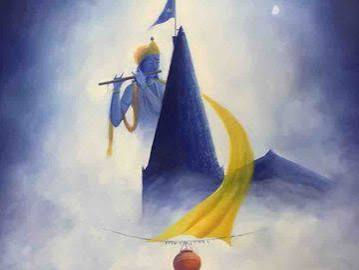
His paintings do not need a long explanation. A Krishna with a flute, a festive Janmashtami scene or the familiar landscape of Dwarka can speak directly to the viewer.
For many admirers, that is precisely what makes the work special: the paintings are not simply about who painted them, but about the emotion that they communicate.
A Message Beyond the Canvas
The popularity of Fakruddinbhai's paintings has grown particularly around Janmashtami, with his works receiving attention on social media.
Yet the real story lies deeper than their online popularity.
At a time when conversations about identity can often become divisive, his canvases offer a different picture — one in which an artist can find inspiration in a tradition beyond his own religious identity and express that inspiration sincerely through his craft.
His brush becomes a meeting point between art and devotion, between personal experience and shared heritage.
The Artist Who Lets the Canvas Speak
Fakruddinbhai does not need to paint a message of harmony in words. His Krishna paintings communicate it through their very existence.
Decades of experience, memories of Dwarka and a deep artistic engagement with Krishna have come together on his canvases. What began as an artist's personal expression has now become a source of admiration for many who see in his work something larger than a beautiful painting.
In Jamnagar, a brush moves across a canvas.
Blue, gold, colour and light come together.
And Krishna appears.
The painting belongs to the artist who created it. But the emotion it evokes belongs to everyone who sees it.
That may be the quietest — and most powerful — thing about Fakhruddinbhai's art: it reminds us that beauty does not ask who we are before it touches us.


Comments